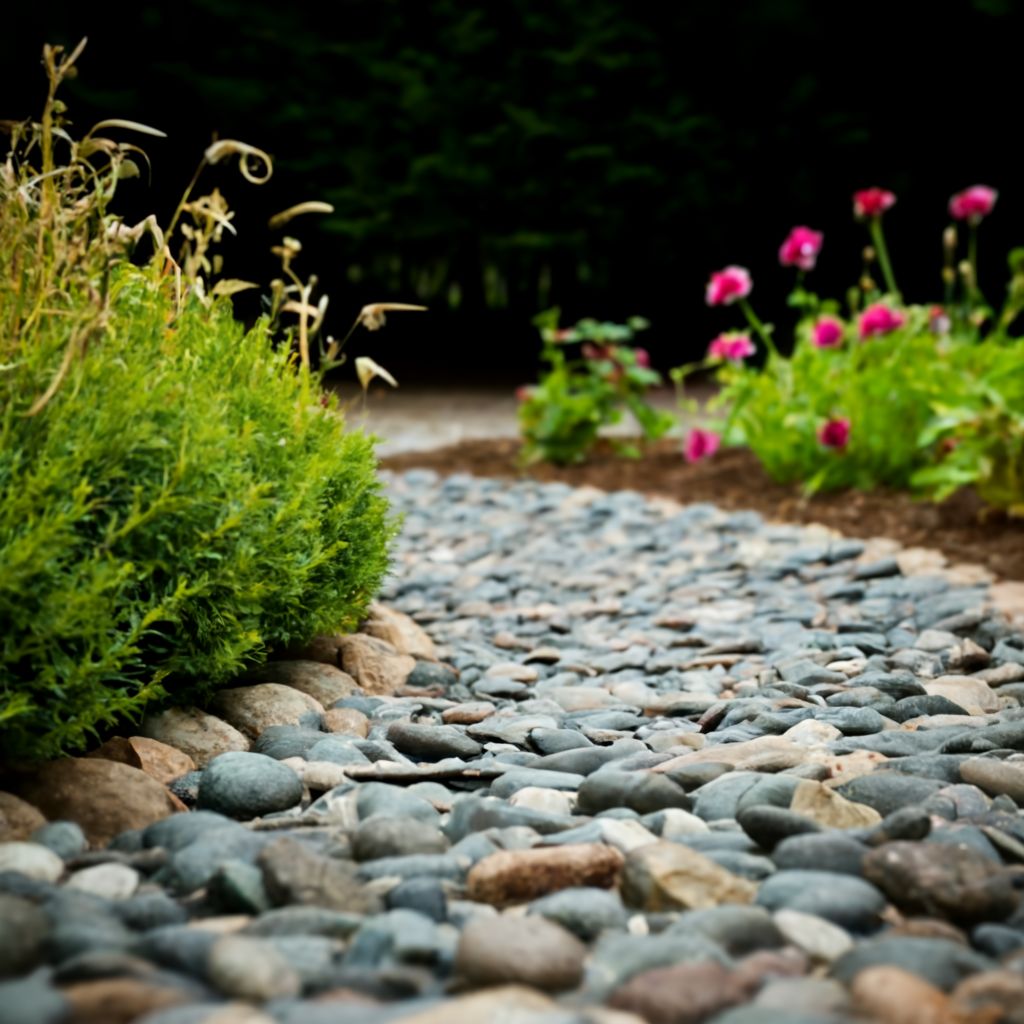





Hyacinth Orientalis 'Aqua'
- In stock, ready to ship
This magical color-shifting beauty has deep aqua-purple florets with blue-purple midveins. It pales as it matures. Bulb size: 16/17 cm. Full to partial sunlight. Bloom time in horticultural zone 5: April. Plant 6" deep and 6" apart. HZ: 4-8. Height: 8" to 12".
Hyacinths are The Art, Soul and Fragrance of Spring.
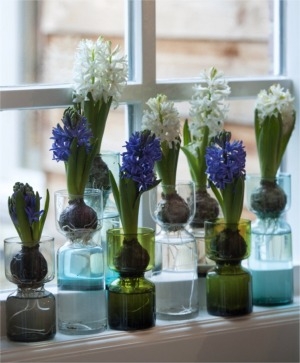 To force a Hyacinth means to pot the Hyacinth bulbs in soil or place them in a Hyacinth glass in water, replicate winter conditions and bring them into bloom earlier than their normal spring bloom time. One can force a Hyacinth to bloom earlier, but cannot force a Hyacinth to bloom later.
Hyacinth Variety Selection
Hyacinths are among the best flower bulbs to force over the winter.
While all Hyacinths are good forcers, some are particularly good for earlier blooming pots, while others are good for later blooming pots.
Hyacinth Skin Irritation
Some people develop an itchy reaction to touching Hyacinth bulbs. If you ever have had such an irritation, or if you don’t know how you will respond to touching Hyacinth bulbs, it is best to wear protective garden gloves. Then, take care not to touch your face or rub your eyes with your gloved hands. There is nothing to worry about if you do have an itchy reaction, as annoying as it may be. Just wash the affected area with soap and water.
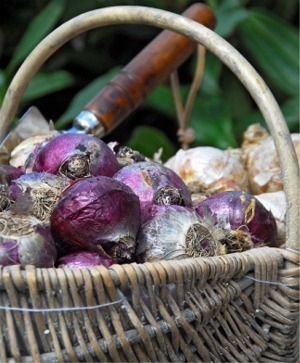 Hyacinth Bulb Inspection
Inspect your bulbs carefully. We make every effort to ship you only healthy, firm, top quality bulbs. It is natural for some types of bulbs to develop a natural gray-blue-green transportation mold when they are exposed to oxygen. Little cuts, scars, discolored exteriors and dimples are normal marks from the flower bulb harvesting, cleaning and sizing processes in the Netherlands.
Some bulbs may have a fully intact, papery skin, or tunic, while some have partial skins, and others may be skinless. The condition of the skin has nothing to do with bulb performance. As long as the bulb is firm, it is a good and viable bulb. Some bulbs may already have tiny baby bulbs developing on the basal plate, or root base, of the bulb (not usually the case with Hyacinths). Some bulbs may have a little top shoot visible. And some bulbs may have old hairy roots on the basal plate, while others have none.
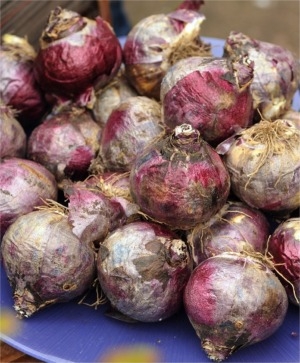 You may notice that the Hyacinth bulb tunics may be different colors. Among all flower bulbs, Hyacinths are the only bulbs that may have different colored tunics by variety. For example, Hyacinth Gypsy Queen has a mottled purple and ivory tunic, while Hyacinth White Pearl has a silvery-white exterior and Hyacinth Blue Jacket has a deep magenta tunic.
Hyacinth bulbs can exude a smelly viscous substance that is, unfortunately, called snot in Dutch. This can be wiped off with a paper towel. However, if you find a Hyacinth bulb with any soft spots into which you can push your finger, please let us know. Inferior bulbs should never be used for forcing.
Preparing Hyacinth Bulbs for Precooling
Once you receive and inspect your Hyacinth bulbs, you must decide how you will force them: in a pot with soil, or in a Hyacinth glass or vase with the bulb suspended just over the water.
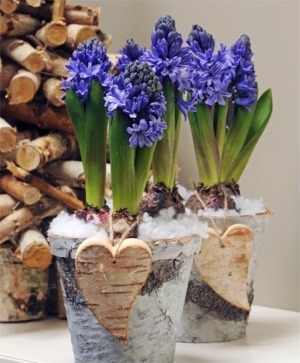 Forcing Hyacinths in a Pot of Soil
Select the proper sized clay pot, or, preferably, a clay bulb pan, with good drainage. Garden club competitions often specify usage of an 8" clay bulb pan into which eight size 16/17 Hyacinth bulbs would be nestled. A bulb pan is less deep than a standard pot. Its broader and lower base provides good stability for fully blooming pots of forced bulbs that can become top heavy. They usually have a thick clay rim that makes lifting and moving the bulb pans easier.
Use a good, sterile neutral pH potting soil. Select a potting medium that will support the growing flower bulb and hold enough moisture for proper root growth.
Place a broken pot shard in the drainage hole at the bottom of the pot to prevent soil seepage when the pot is watered.
How many bulbs per pot? We say as many bulbs as will fit shoulder to shoulder! We like nice, full pots of flowers. Most prefer to snap off any little baby bulbs from the sides of the mother bulbs (not usually an issue with Hyacinth bulbs) to ensure the highest flower count per pot.
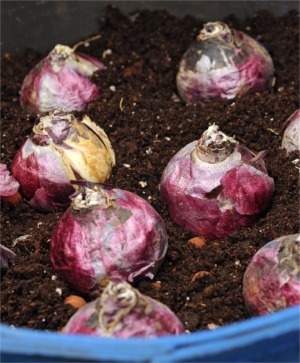 Fill each pot half way up with potting soil. Nestle the flower bulbs (root side down) in the pot. Fill the rest of the pot up with the potting soil to 1" below the pot rim. Tamp down the soil lightly and add a bit more soil if necessary so that the soil level is still 1" below the pot rim. This is so that the water and soil won't slosh over the sides when the pots are watered.
Place plant labels in each pot to identify the variety being forced and the date you are putting it into precooling. Keep a record of which varieties force well for the future.
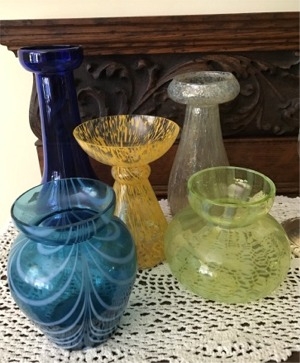 Hyacinth Glasses
Forcing Hyacinths in Hyacinth glasses or vases is an extremely satisfying pre-winter nesting ritual. It is practical, soul-warming and so very romantic. But we must warn you: it can grow into an obsession before you know it, particularly if you start collecting antique Hyacinth glasses. Both Hyacinth orientalis and our Multi-flowering Festival Hyacinths may be forced in vessels allowing them to be suspended just over the water.
Dutch Hyacinths have been the object of obsession as flowers forced in glass vases for over two centuries. Most of the old, antique vases were produced in western Europe, specifically in England, Holland, Germany and France, as well as in Scandinavia. They were not always simple glass vessels that supported the bulb over water either. During the Victorian era, from 1837 to 1901, exquisite Hyacinth vases were hand blown in a variety of rich colors: cobalt-blue, cranberry, amethyst, teal- to emerald-green, citrine-yellow and shimmering clear. There are several characteristic Hyacinth glass shapes and forms: bulbous and squat (around 5" to 6" tall), churn-shaped and tall (around 8" tall) and all sizes in between.
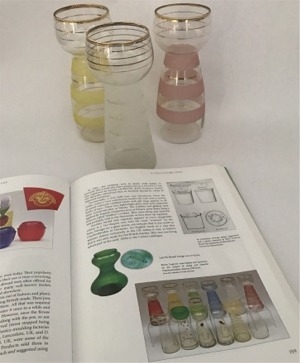 The earliest, and most valuable, are hand-blown glass with admired individual irregularities. Hyacinth glasses adorned with etching, intricate feet or pedestals, enameling, painted designs and intricate decorative glasswork are most rare. These magnificent vases helped to enhance the extraordinary beauty and prestige of forced Hyacinths in stately Victorian-era homes.
Later, starting in the 1850s or so, glasses were often mold-blown, the most well-known being the "Tye" Hyacinth glass that was short and bulbous with a little top rim. Other Hyacinth glasses have larger top rims. There are also ceramic and terra-cotta Hyacinth vessels but we don’t prefer them because we can’t see the root growth and they don’t emblazon our window sills with the rich jewel-tones of the glass vessels.
You may use more containers for Hyacinth forcing than proper Hyacinth glasses. Depending on the size of the bulbs, we’ve found that jam jars, narrow-mouth Mason jars, regular little vases with smaller openings and even tea cups can work! The trick is to find a vessel into which the Hyacinth bulb will fit but remain suspended over the water. The vessel should be stable and remain so, even when the bulb is in full bloom with a plump, 8" flowering spike atop the bulb.
You may want to consider precooling the Hyacinth bulbs in containers other than your prized antique glasses in case there is a refrigerator malfunction during which time the water in your prized glasses could freeze and break the glasses. After the precooling period is up, you would simply transfer the rooted and sprouted bulbs into their special vessels.
The Precooling or Rooting Process
Place the Hyacinth vases or potted Hyacinths in a dark refrigerator or cooling unit set at a consistent 40°F to 48°F with moderate ventilation for 8 to 16 weeks. Darkness is a must. This consistent temperature range is a must.
If your bulb refrigerator is in an unheated room or garage, keep your eye on night time temperatures. If it is going to be significantly under the 40°F, it will lower the temperature inside the refrigerator and risk damaging the bulbs (and Hyacinth glasses).
If you don’t have a refrigerator or cooling unit and intend to precool them in an unheated garage, basement or attic, buy a maximum-minimum thermometer so you can track the temperatures. Place the Hyacinth glasses or potted Hyacinths in an ample cardboard box (like our large exterior shipping carton) so they are in the dark. Again, a dark, consistent 40°F to 48°F temperature is key to the precooling process.
You may also sink potted Hyacinths in an outdoor cold frame or trench and cover them with a 6" to 8" layer of salt hay or sand to over winter them.
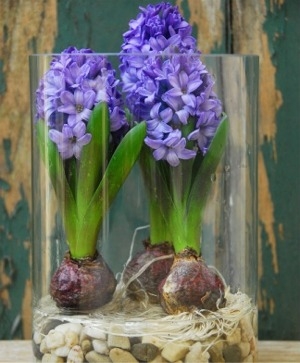 Check the potted Hyacinths and the Hyacinth glasses once a week or so to see if the pots need to be watered, or to bring the level of the water up in the Hyacinth glasses. If the water in the Hyacinth glasses becomes discolored, you can change the water, making sure to tuck all of the Hyacinth roots back into the water.
When to Remove Hyacinths from Precooling
We’ve given you a wide range of time for precooling: 8 to 16 weeks. This is where the art of Hyacinth forcing comes in.
Either during or after the development of a good root system, you will begin to observe the growth of a pale greenish-yellow sprout. Patiently check on the Hyacinth bulbs weekly, watering or refilling the water in Hyacinth vessels and watch the development of the top growth. Over these weeks, the top sprout will thicken as the bud begins to emerge. Once the top sprout is about 2" tall, and there is a substantive feel to the enclosed bud hidden within the top growth, you may start to bring them into a very low light environment in a spot with a temperature of around 60°F. Please don’t bring them out and put them in a greenhouse or on a windowsill with bright light. It would shock the new pale greenish-yellow sprouts that have been in the dark. They need some time to acclimate themselves and slowly begin chlorophyll production to green up.
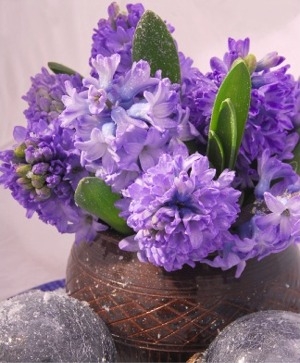 After a week or two, the pots and Hyacinth glasses may be moved into progressively brighter sunlight. Yet still avoid bright direct sunlight: keep them in an area with a temperature around 60°F and rotate them every now and again to help keep the flowering spikes straight. Keep watering as necessary.
Once the flower buds color up, the pots or Hyacinth glasses may be placed anywhere for maximum viewing and enjoyment. Just remember, that the cooler the ambient temperature, the longer the flowers will thrive. If any of the Hyacinth spikes become too tall or floppy, they may be cut for vases. Once Hyacinth bulbs have been forced, they are spent and may be discarded.
If we had to say how long it takes to force Hyacinths into bloom, we would have to say between 12 and 20 weeks.